Wednesday, August 25, 2010

Dead Good Name for a Cafe

If you were going to open a cafe, you'd probably want to give it a name. Preferably something meaningful and memorable. Directly meaningful names like "The Cafe", "The Coffee Bar" or "The Snack Bar" are non-starters in a town that sets up a new sixth form college and doesn't call it "[Town name] Sixth Form Centre" or "[Well known historical figure with an association with the town] College" but something entirely random (One, brainchild of Suffolk County Council, I'm referring to you).

Anyway, a cafe in a building that trades in education probably ought to have a name with some sort of "educational association" rather than a bland, straightforward and descriptive name. If it could be a bit ... "exotic" that would be even better. What better then than a foreign word that has some sort of mathematical association? (the institution in question doesn't offer a BSc in Maths, btw, but it should be obvious by now where this is heading).

Here, then, is the name and something approaching a rationale:
UCS Union's new café - Theta - will officially open for business on Thursday 2 September 2010.
[...]
Theta shares the space with the new Waterfront Gallery, managed by the School of Arts and Humanities, which will open on Tuesday 7 September.
Theta is the eight [sic] letter of the Greek alphabet and is widely used in the sciences, in particular as a mathematical symbol, making it an appropriate choice for a café in an educational institution.
Oh gosh. That sounds well impressive. It's foreign, it's got something to do with education (albeit not in a discipline one can actually study at the institution) and err ... well that's it. Or rather it is until one digs a little deeper.

This is from the entry for "theta" in the popular online repository of knowledge Wikipedia (doubtlessly pasted-in from somewhere else):
In classical Athens, [theta] was used as an abbreviation for the Greek θάνατος (thanatos, “death”) and as it vaguely resembles a human skull, theta was used as a warning symbol of death, in the same way that skull and crossbones are used in modern times. It survives on potsherds used by Athenians when voting for the death penalty. Petrus de Dacia in a document from 1291 relates the idea that theta was used to brand criminals as empty ciphers, and the branding rod was affixed to the crossbar spanning the circle.
Seems like the naming committee have pulled a killer name out of the hat then. It should pull in the punters in droves ... unlike its clumsily named predecessor, Couture.

Friday, August 20, 2010

Thursday, August 19, 2010

Schelling Out

Here's a video recording of Jesse Schell's recent presentation on game development at the DICE 2010 conference. Schell considers the economics of online games [particularly Facebook games, including the ubiquitous Farmville]. Here's some interesting facts:
FV > T

There are more Farmville players than there are Twitter accounts.
LG > DP

Lead generation is greater than direct payments (first they hook you in, then they hit you up).
Facebook is strange

Facebook is strange when compared to retail economics.

Schell links various "unexpected" aspects of recent games development (the success of Facbook games, plastic add-ons/input devices, "achievements", etc, by referring to psychological aspects--he calls them "tricks"--of game design.

When (drawing on Jim Gilmore and Joe Pines's Authenticity: What consumers really want), Schell goes on to talk about how contemporary culture has an aspect of "reality" or "authenticity" that is designed to allow consumers to believe they can get beyond "the bubble of fake bullshit", I think he's referring to what the Frankfurt School might have called "false consciousness".

This is such interesting stuff you'll want to watch it twice.


Games and platforms discussed include Mafia Wars, Farmville, Club Penguin, Wii, Wii Fit, Guitar Hero, Webkinz.

Wednesday, August 18, 2010

Looking for the Truth

I've been working on a machinima project using Moviestorm 1.2. It's the most ambitious piece of machinima I've made to date, involving voice actors and a proper script. The finished piece has a running time of fourteen minutes. I'll be submitting it as an entry for the 2010 MachinExpo, as well as entering a subtitled version in the Stars and Storm competition on TheMovies.fr.

Here's the teaser text interspersed with some production stills:


Harris wakes up naked, scratched and bruised in an abandoned house.


He tells Bengie, his flatmate, that he can't remember much about the night before.


Meanwhile, Amber's friend Jessica appears to be missing.


Is there a connection?


Bengie and Amber want to know what happened.


They're all looking for the truth ...


The film can be viewed on Vimeo: http://vimeo.com/14088489
Here's a link to the version with subtitles: http://vimeo.com/14221744

It contains nudity and strong language.

Monday, June 14, 2010

Notes from a Small Island

There's an interesting ex-patriate story in a recent edition of The Daily Telegraph about a Scotsman who emigrated to New Zealand and then became a volunteer IT trainer in The Republic of Vanuatu, a group of islands in the South Pacific formerly known as the New Hebrides.

What's particularly interesting is that the ex-pat is using Moviestorm as a machinima platform with the youth group members of an educational theatre group, the Wan Smolbag Theatre, based in Vanuatu's capital, Port Vila.

The Telegraph article is here: Making Movies in Vanuatu.

Some of the youth group's work can be seen here: Moviestorm Animation Club. These young machinimators are modding Moviestorm and using Google Sketchup to create their own props.

Here's the first film they made (it shows the Wan Smolbag Theatre); check out the modding:


Their most recent production is here:


Here's is a link to the Wan Smolbag Theatre group's moviestorm channel: WanSmolbag. The ex-pat in question, btw, is John Herd, better known to those who frequent the Moviestorm forums as Primaveranz.

Monday, June 7, 2010

Keeping it (un) real: Serious Games


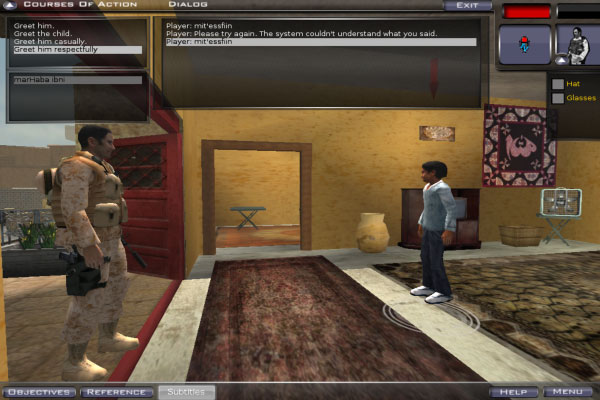
Mike Shaugnessy of Washington & Jefferson College, Pennsylvania, is currently guest-blogging on BoingBoing. He recently posted about "Tactical Iraqi", a language and culture simulation/training application, developed at the University of Southern Califormia using Unreal Technology and funded by the US military's Defence Advanced Research Projects Agency (DARPA).

Shaugnessy also notes that the Americans have built facsimile Iraqi villages in the California desert "so soldiers can practice their interactions with [pretend] locals and [cod] insurgents and get the authentic feel for life in Iraq as an occupying force". Similar facsimiles have been created in the UK in a forest in Norfolk and in Somerset, but as of yet there is no film version (Full Battle Rattle is set in an American training facsimile of an Afghan village).

What's interesting is the use of FPS gaming technology to recreate real locations to provide simulation and training that *doesn't* have any shooting in (that's right: the interactions are verbal and gestural and don't include rocket launchers!). "Tactical Iraqi" has been around for a while, as this BBC story shows, and has picked up several awards, including a DARPA award in 2005. It was first built using UT2003. Shaugnessy's BongBoing post refers to the latest release (October 2009), but doesn't note if the developers have updated to a newer Unreal engine. There are now several "Tactical Language" spin-offs, including "Tactical Pashto", "Tactical Dari", "Tactical French" and "Tactical Indonesian". While "Tactical Levantine" seems to have been dropped (see that BBC story) a "Tactical Jive" or "Tactical Urban Street Argot" might be useful for facilitating some local integration.

There is some interesting discussion of the development and play testing here: http://www.awn.com/articles/gaming/learning-languages-games-itactical-iraqii

Unfortunately, there's no downloadable demo available (athough anyone with access to a .mil email address can download the software for free) but a video and a brochure can be found on the Alelo website.

Other video clips can be found in all the usual places. This one's from DailyMotion:

The American military has a long history of using games technology for training, as this article by Roger Smith Simulation and Gaming 41.1 (February 2010) shows.

Acclaim for the "Tactical Language" simulations is not universal, as shown by this post on Watercooler Games by academic cum games designer Ian Bogost.

Sunday, June 6, 2010

machinima


DSCN2401
Originally uploaded by collegecollage
That telly's actually quite big when you stand close to it