Monday, June 6, 2011

Look Back in John Peel's Shed

I saw John Osborne's one-man show, John Peel's Shed as part of the @PulseFringe festival in Ipswich recently. I liked the show for a number of reasons. First, I was intrigued by the title because I know that John Peel kept his records in various outbuildings around his gaffe in Stowmarket, and also because I used to listen to John Peel as a teenager. It was a bit like Top of the Pops, a cultural fixture at which attendance was almost compulsory. I also used to regularly read John Peel's column in Sounds, and still think of Mrs Peel, aka Sheila as "The Pig" and of offspring William as "William (A Baby)". It's a little odd to think that even smaller Peelings, as then unborn, now speak to me in the earhole through the radio. But I digress.

I enjoyed John Osborne's show for its premise: Osborne, also a John Peel listener, albeit from a different era, had won a competition involving coming up with a slogan as to why the John Peel show should win a Sony radio award, and he (Osborne) was duly rewarded with a prize that consisted of a box of records from John Peel's shed which were delivered by a couple members of the production staff to Osborne's humble student abode in Norwich.*

Osborne had the contents of the box records spread out on the floor of the Wolsey Studio and he regaled the audience with stories about his experience as a radio listener, and he also played some tracks from the records he had won.

I enjoyed the show because of the way it span out into other areas: we learned that Osborne was so burdened with the responsibility of using and sharing his treasures that he inveigled his way into a community radio set-up in Norwich, undertook a production training course and recorded a series of shows in which he played some tracks from his box of records. Osborne conceded that there probably wasn't anyone listening to his broadcasts (I suspect this is true of many if not all community radio stations, but at least their existence allows someone to tick a "community engagement" box somewhere) but I admired the effort and the story it allowed him to tell. The story was interwoven with snippets of information about Osborne's life, radio listening habits and employment history, each of which were inspiring, enlightening or amusing in their own way.


The gig however, may have been little more than a pretext for Mr Osborne to whip out a pile of books (I think he had ten copies under the coffee table which was part of his set) and offer them to the audience at a fiver a time. I had spotted the books fairly early on and anticipated or partly hoped that at some point Osborne would distribute them for free. Ever the optimist, I had assumed that I would probably be awarded a copy, perhaps as a "reward" for asking an interesting or amusing question, or for sharing one of my own radio-related anecdotes. I was a little surprised then, if not ever-so-very mildly put out, that the tomes merely formed the basis of a vulgar transaction. However, my displeasure was somewhat alleviated when, while still sitting in the front row, I looked at the price of Radio Head on Amazon and saw that it was being offered there for some six pounds odd. The bargain-hunter within me was alert to the opportunity to bag a copy for a fiver and also to get it inscribed by the author, which would surely add to its value. However, by this time the swell of the departing audience had swept me into the foyer and then out into the night and the opportunity was past (I didn't fancy battling my way back up the stairs, against the flow of the small crowd, such as it was, to cop a copy for a fiver when the call of the pub was strong and a couple of pints could be had for the same price).

If I haven't already noted the fact, then I have been remiss, but it should be recorded that part of my enjoyment of the show resulted from the fact that it prompted me to recall some of my own radio-related experiences. Here then are some:

1) The only time I ever met John Peel that I can recall was in a bar at a pop festival. I think it was Reading and I think it was 1979. The bar was a tent and I think it was a backstage bar. (I don't recall how we blagged passes, but I've a vague recollection of wearing a black and white sticker on a t-shirt.) It was also an empty backstage bar, apart from a lone bloke standing in the middle of the tent. I was at the entrance to the tent with my mate Leaney. "That's John Peel" he said. So I went up and said hello. I'd like to think that I also mentioned liking his radio programme and that at least one of us offered to buy him a drink, but we were probably skint and wouldn't have had the resources to do so. On the other hand, at least one of us would almost certainly have tried to have blagged a drink, but whether or not this was in fact the case remains uncertain, and that's how this shaky recollection must end.

2) Sometime in the early-to-mid 1970s Tony Blackburn had the breakfast show on Radio 1 and handed over to "Diddy" David Hamilton (no, not the film maker) for the next slot. One day, however, TB announced that they would be taking the radio car to London Zoo so instead of getting the bus to school, when I got to Golders Green station, instead of getting on the 102, I got on a bus going in the opposite direction (2B?) and went to the zoo instead. After wandering around for a while I came across the radio car, with its huge aerial up in the air, and chatted briefly to Messrs Blackburn and Hamilton. Imagine my surprise when I was called into the House Master's office at school the next day and asked to explain my absence. Apparently the House Master's wife had been listening to the radio, heard me on air and had grassed me up. What a cow!

3) Another time in the early-to-mid 1970s a new radio station started, called Capital Radio (194MW). For some reason a nearby VW garage was promoting this launch, or had somehow tied it in with the launch of a new model of one of their cars, and they were giving away glasses of cider (actually, they weren't glasses, but were those white plastic cups) along with helium-filled balloons and Capital Radio (194MW) t-shirts. The promo girls didn't seem to mind who they gave the cider to, or how much they gave, so I took repeated advantage of their generosity. And I got a T-shirt as well.

4) That actually wasn't the Capital Radio-related anecdote that I originally had in mind (it just came to me while I was bashing out the bit about John Peel in the beer tent). The actual Capital Radio-related anecdote that I had meant to recount is this: a DJ called Dave Cash, who I think had the mid-morning slot or possibly the early afternoon show, was inviting people to ring in or send a postcard with amusing tales of how they procrastinate. Capital Radio mugs, pens, pencils, T-shirts and the usual bits of freebie ephemera were all offered as inducements. One of these days I'm going to call them on that and get one of those mugs and t-shirts.

I think that's enough radio-related anecdotes for now. However, I should also record that, during the show John Peel's Shed, I did feel something of a brief if fleeting affinity with John Osborne. Some of it due to the connection we shared in John Peel, but some also because of our shared habit of radio and some linked listening experiences. Osborne talked of Resonance FM, and I was reminded of the time I sought it out for the show "Where's The Skill In That" which was the temporary home of Robert Sandall and Mark Russell's "Mixing It", which was not only a brilliant programme that opened the ears of many listeners (and picked up Sony awards for Radio 3) but was so cruelly dropped from the airwaves that I was moved to write a letter of complaint to the BBC. Osborne also talked about the time he listened to Tommy Boyd who had a phone-in show; I used to listen to Tommy Boyd on LBC when he was bought in to fill the slot previously occupied by Jeremy Beadle (yes, that one) who had either left, or was dropped. It wasn't the same phone-in as Osborne's but I was a listener. And a caller (to both Boyd and Beadle).

So much did I enjoy John Peel's Shed that I actually sought out a copy of John Osborne's book, Radio Head, which I found for 60p via ABE Books. However, the postage was £1.45, so it wasn't quite the bargain that it might have been, although it was considerably less than a fiver so I'm still quids in, or the price of a pint. I'm currently reading and enjoying the book, even though some of the anecdotes are already familiar to me from John Peel's Shed. I'm also considering undertaking a radio production course for the local community radio station, even though it is probably the case that no-one will listen. (I have ideas for a show too, but the community radio idea and a 'speak your brains'-style phone-out were formulated some time before I'd even got tickets for John Peel's Shed, much less seen the show or read the book).

That's all we've got time for pip pip pip pip pip piiiiiiiiip!


* As far as I am aware, all student abodes are humble, not just those in Norwich. If, however, John Osborne's student abode is not deserving of the epithet, I am happy to be advised accordingly and make any necessary corrections.

Mind the Gap!

Oh golly, I haven't posted to this blog since September last year! How very neglectful of me. Next time I am preoccupied I shall try to remember to take a little time out of my busy schedule to post a little something, even if it's just a short, two-line comment on an otherwise inconsequential scintilla of a thought, for you, dear reader, for you.

Thursday, September 23, 2010

The Ipswich Regent: Suffolk'n Ripoff!

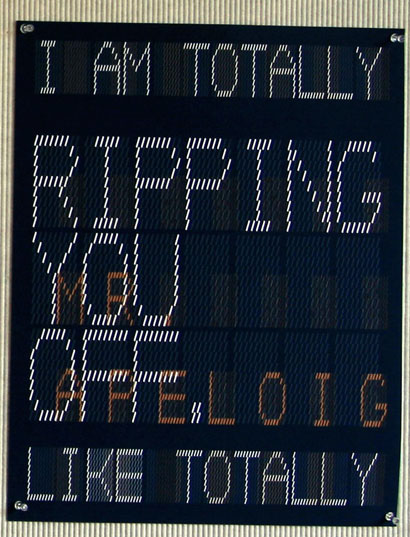
Splendid as it may be that The Ukulele Orchestra of Great Britain will be playing at that most august of venues in the county town of Ipswich, namely The Regent, it's more than a little flabbergasting to discover that the price of each ticket is inflated by an extortionate £2.00 if they are purchased with a credit card, debit card or a cheque.

Four £23 tickets in the stalls should cost £92 (not cheap by any means, but positively inflated when one considers the downbeat ambience of this parochial venue) but it seems nothing short of daylight robbery when the venue bumps up the total to £100.

Just to set this ticket price scam in context, The Barbican (which is neither downbeat nor--except for those living on the Barbican estate--parochial) charges a booking fee of £2.50 per telephone transaction, and that includes first class postage if there's time! (if not, the tickets are held at the box office). There's a charge of £1.50 for online bookings and again, tickets are sent via first class post (in lovely little orange envelopes).

The Southbank Centre doesn't stiff concert-goers either: there's a £2.50 fee per telephone booking or £1.45 for online booking. As with the Barbican, the fee is applied to each transaction, not each ticket.

I think that in order to register my displeasure at the contempt Ipswich Borough Council/The Regent clearly displays toward the mugs who pay their wages ticket-buying public, it would be fitting to buy tickets in person at the box office and offer payment in pennies. Unfortunately, however, as the Royal Mint points out that 1p and 2p coins are legal tender up to 20p, I might have to be a bit more creative. The 5p coin is legal tender up to £5, as is the 10p. The 20p is legal tender up to £10, and so it the 50p. The £1 is legal tender in any amount. It looks like it could be £30 in silver and sixty-two pound coins. Unless I go with my chums and we buy one ticket each, maxing out the disconvenience of paying with 5p, 10, 20p and 50p coins. On the other hand, I could save myself the hassle of getting lots of coins out of the bank and let the poxy Regent stick its tickets where the sun don't shine.

Replay: A History of Video Games

Cover image: Replay: The History of Video GamesThere's a review in today's paper of a new book purporting to tell "the" history of video games (I always think "a history" is preferable: the definitive ambition of "the history" may be a little hubristic).

Fatal flaw of the title aside, it looks quite interesting. According to Keith Stuart's review,

Replay: The History of Video Games by games journalist Tristan Donovan is a[n ... ] up-to-date and thoughtfully written opus. Beginning with the switching on of the first programmable computer in 1946 and closing with the rise of downloadable indie games, this engrossing work manages to touch on every vital facet of the industry, from the formative battles between Atari and Mattel, through the rise of the home computer to the emergence of the Japanese home console empire.


Apparently Donovan includes a consideration of MUDs, which are often overlooked in such works (I know that when I talk about MUDs to students, it's usually the first time most of them have heard of such things). Clive "C5" Sinclair gets some coverage for his pioneering work in developing computing in the UK.

It's £12.99 in the shops and surprisingly expensive at £12.34 on Amazon. If it was more heavily discounted (under a tenner) I'd snap up a copy without thinking twice (Amazon must love me) but Amazon's piddlingly small "discount" is a psychological block that's cost them a sale. Instead of copping myself a copy, I'll ask the library to add one to stock.

Wednesday, September 22, 2010

The Social Network: Free Soundtrack

Trent Reznor and Atticus Ross have scored David Fincher's new film "The Social Network". You can score a free five-track EP of music from the film at http://www.nullco.com/TSN/

Wednesday, September 8, 2010

Free Audio Books

The Guardian is running a promotion this week, whereby readers can download free audiobooks from audible.co.uk. A different title is made available each day.

Saturday: The Girl with the Dragon Tattoo by Stieg Larsson [Audible link]
Sunday: Armando Iannucci's Charm Offensive [Audible link]
Monday: Sir Charlie Stinky Socks and the Really Big Adventure by Kristina Stephenson [Audible link]
Tuesday: Matter by Iain M. Banks [Audible link]
Wednesday: Down and Out in Paris and London by George Orwell [Audible link]
Thursday: Rapid French: Volume 1 by Earworms Learning [Audible link]
Friday: Yes Man by Danny Wallace [Audible link]

Each free download is only available for a week, so don't hang about.

The way it works is users have to create an account with audible, and each of the free audiobooks is added to a virtual shopping basket and purchased for a cost of £0.00. Each audiobook is then downloaded using the audible download manager. No purchase is necessary, and no credit card details are required to set up the account.

One problem with this is that Audible uses a proprietary format for the files: they aren't .mp3 or .ogg, but a peculiar .aa format (shame on you, Guardian, BTW, for going along with this .aa malarkey). Another problem is that the files appear to be very heavily compressed. However, the ingenuity of the internets can help those who don't want to be hampered by a proprietary format. The audible account is flexible enough to require users to specify how--ie on what platform--they want to listen to the files. Available options are "iPod", "MP3 & GPS", "Mobiles & PDAs" and "Computer and CD Burning". Select "Computer and CD Burning".

The third problem is that the only way to get the files is to use the audible downloader, so you'll just have to install that and dump it later. So complete the sign-up process, and figure out how to download the .aa file via the downloader.

The next thing to do is to use the google to find, download and install a file called audibleMediaPlayerFilter.exe This is an old application, no longer used by Audible, but installing it will also install an aa-compatible codec, which is needed to open these files before converting them.

You'll also need LAME (Lame Ain't an Mp3 Encoder) so if you don't already have it, go back to the google and find and download LAME. However you get LAME, you'll need to drop a copy of lame_enc.dll into the C:/Windows/System directory. This is needed to convert those pesky .aa files to MP3 format using an application called Goldwave. Note that Goldwave needs to have the lame dll in the C:/Windows/System directory in order to be able to export to MP3, so if you've already got LAME installed, just drag another copy of the dll here.

Go back to the google to find, download and install Goldwave 5.06 Note that later versions of Goldwave will expire, so make sure to get 5.06.

Finally, just open the downloaded .aa file with Goldwave and save it as an MP3.
(This method doesn't work with .aax files, Audible's so-called "enhanced" format. In this set of free downloads, only the Rapid French title uses the aax format.)

As an alternative to exporting as an MP3, export the file from Goldwave as a wav file, then open the wav in CDWave (a shareware app used by audiophiles) which is nicer than Goldwave for tracking, and add track divisions or chapter points.

Goldwave can also be used for tracking, using what it calls "cue points", but it involves quite a bit of scrolling and zooming in Goldwave to place the cue points, while the process is more straightforward in CD Wave (CD Wave only reads lossless WAV or FLAC files).

Last time The Guardian got together with audible.co.uk to give away a free audioboook, there was an embedded player on the page with the option of streaming the file, downloading it as an MP3 or using some subscription service thing called iTunes. While the streaming/downloading options were better than the current offering, the book was Wolf Brother, a fantasy tale aimed at younger readers/listeners, by Michelle Paver. However, it didn't expire after a week and, three years later, it's still available here: http://www.guardian.co.uk/books/series/wolfbrother.

Tuesday, September 7, 2010

From Gameboy to Armageddon

accompanying pictureThis fascinating programme on BBC Radio 3 is a repeat of an earlier broadcast in February 2010.

The programme discusses the use of gaming technology in warfare, combat training, and even recovery and recuperation. The phrase "military entertainment complex" nicely captures the scope of the programme. (According to Tim Lenoir, All But War is Simulation [see footnote #4 on page 292], the phrase (which is a re-working of "military-industrial complex" which refers, literally, to the business of killing people) was, apparently, first used by Bruce Sterling in "War is Virtual Hell" in the first issue of Wired magazine (March/April 1993). While Sterling certainly discusses the developing synergy between the military and gaming technology, he doesn't quite coin that wonderful phrase.)

There is some discussion of the morality of gameplay--for example, having to kill "wounded" opponents or bots to win Full Spectrum Warrior--but interestingly, while the media often raises questions about the morality of videogames, the question of the morality of warfare per se doesn't even appear as a blip on the programme's radar screen.

It hasn't yet hit the BBC iPlayer, but will appear shortly: http://www.bbc.co.uk/programmes/b00qps1j. Alternatively, the marvellous RadioDownloader offers a convenient way of grabbing radio programmes that might otherwise be missed.